
How Sea Cables Support Global Connectivity
July 20, 2026 by Robert Dalton
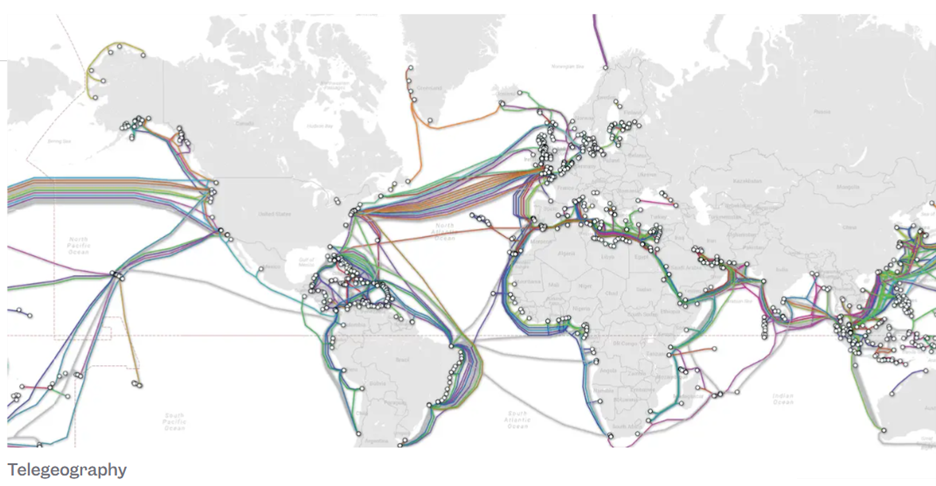
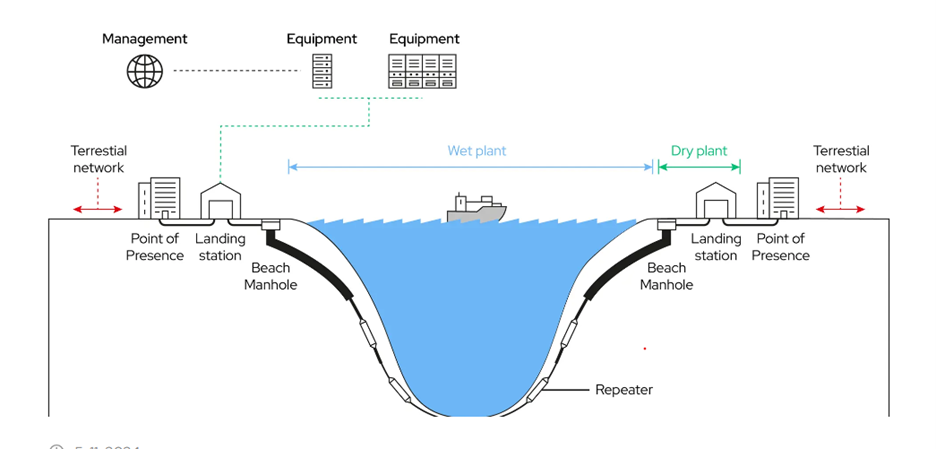
All sea cables connect to Sea Cable Landing Stations (CLS) which are located where those sea cables come ashore, thus linking Tuas CLS in Singapore to San Luis Obispo CLS in Los Angeles, Halifax to Liverpool, Marseille to Singapore, Miami to Sao Paolo, and other major routes around the world. Over the last few years, Cogent has been connecting to CLS or as close to them as possible, to carry the huge traffic landing ashore to additional destinations.
Connecting into a CLS provides a few clear advantages. Submarine cables offer direct transoceanic routes between international locations, which keeps latencies low. Sea cables currently provide 98% of international connectivity, and data volumes keep growing. Multiple sea cables come into the same CLS station, so if one route goes down, traffic can reroute across the others. That's network diversity built in. For example, the Tuas CLS in Singapore has 40 active or under construction sea cables coming into their facility.
Historically, CLS were owned by telecom operators. Later, they were financed by consortiums of multiple operators. Today, most sea cables are financed by hyperscalers and the OTT. In addition, sea cables are often extended from the CLS to Carrier Neutral Data Centers (CNDCs) in the vicinity – providing broader carrier access to the cables.
Being close to the CLS is necessary to access the sea cables, but also to reduce latency. Operators, Carriers, hyperscalers, neoclouds are all present in CNDCs close to the CLS such as CoreSite One Wilshire, Digital Realty Marseille, Equinix Singapore. Similarly, Financial firms will connect to the Chicago Mercantile Exchange from CNDCs in Aurora, IL or other surrounding areas, then use sea cable capacity to connect to Frankfurt in Europe or Tokyo in Japan for low latency trading.
Cogent has been connecting into CLS and coastal CNDCs for years, delivering high-capacity connectivity on the most interconnected network in the world: 1,700 CNDCs worldwide and 7,600 ASNs. Earlier this year, Cogent extended its reach to CLS in Boca Raton, FL, Myrtle Beach, SC and Virginia Beach, VA. With these three locations, Cogent can deliver both large capacity Optical Wave Service and IP Transit services to customers landing in these CLS.
Cable Landing Stations are the bridge between the submarine network and the terrestrial one. They keep international connectivity reliable, and that reliability is what lets businesses operate at a global scale.
About the Author:
Robert Dalton is the VP of Premier Accounts at Cogent, where he leads the strategic accounts team serving hyperscalers, neoclouds, CDNs, and carriers. With over 30 years of experience in the telecommunications sector, he brings deep industry expertise to his role. Currently, his team is at the forefront of driving growth fueled by the global AI boom.